Mali Lošinj at the turn of the 20th Century
In the second half of the 19th century, Mali Lošinj with its 7 shipyards and more than 200 ships occupied the third place in the shipbuilding sector in the Austro-Hungarian Monarchy, after Rijeka and Trieste. In 1855 the Nautical School called Nautica was opened; it was located next to the parish church and a new school building was built in the harbour in 1881. The same year, Eugen Jelčić (Kotor, 1854 - Vienna, 1915) was appointed as a new school principal and he held that position until 1895. During his service in Mali Lošinj, he modernized the Nautika School in Mali Lošinj and ran the Astronomical Observatory of the Imperial and Royal Nautical School; he also encouraged the establishment of the Meteorological Station of the Imperial and Royal Nautical School which was conducted by Ambroz Haračić.
Ambroz Haračić, “the most deserving person from Lošinj”, was born in Mali Lošinj in 1855. and in 1879 he started teaching in at Nautica School in Mali Lošinj. That same year, he began with meteorological and climatological research which resulted in development of health tourism, which came at the right time as the maritime development was at the turning point due to the expansion of steamships over the sailboats which the Lošinj shipping industry was based on. Thanks to Ambroz Haračić, Mali Lošinj made a successful economic transition from maritime affairs to tourism. In such a vibrant environment the town of Mali Lošinj continued its further development, having its golden age at the turn of the 20th century.
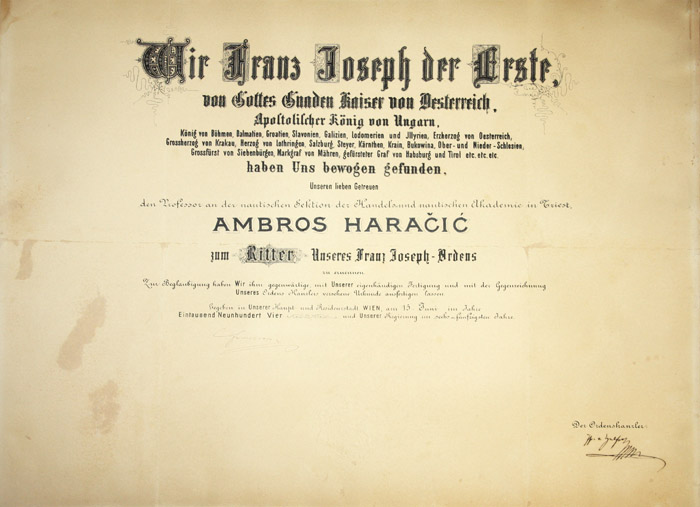
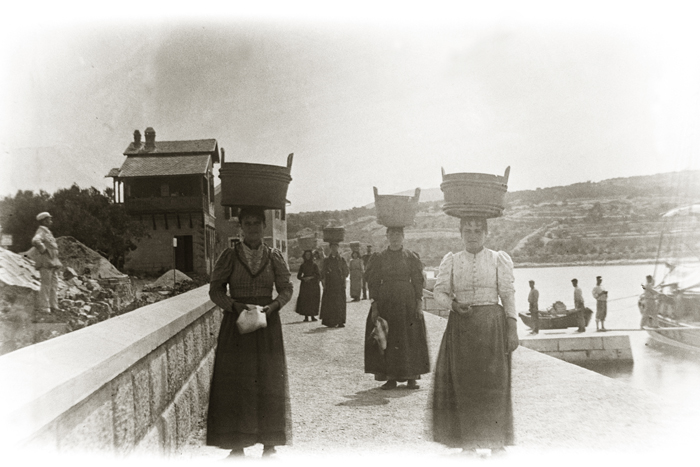
However, the benefit of its overall development was only enjoyed by a minority group of people who spoke Italian language, which was the official language in public administration and other services, but also the language of maritime affairs and international economy. Therefore, the authorities supported teaching in Italian, despite the fact that the majority of the population spoke Croatian. In 1893, the Society of Sts. Cyril and Methodius for Istria was founded with the aim of establishing schools with classes held in Croatian language; its branch was founded in Mali Lošinj in 1898. The first president was Šime Kvirin Kozulić, the initiator of the Croatian national revival in Lošinj. The important role in the revival played the aforementioned Ambroz Haračić, who was actively involved in politics, in addition to his engagement in the fields of education and economy. Haračić died in the midst of the war in 1916 in Mali Lošinj. In 1904, Franz Joseph I awarded him the highest national prize, the Order of Knighthood, for his fruitful work and merits in the development of natural sciences. The greatest achievement of the Croatian National Revival was the opening of the Croatian primary school at the end of 1903. The first Croatian teacher, also the school principal, was Josip Antun Kraljić; he was born on the island of Krk in 1877 and died in Mali Lošinj in 1948. Josip A. Kraljić actively participated in social and cultural life of Mali Lošinj. In the permanent exhibition are displayed Haračić’s portrait and diploma on proclaimig him a Knight, as well as photos from that period.