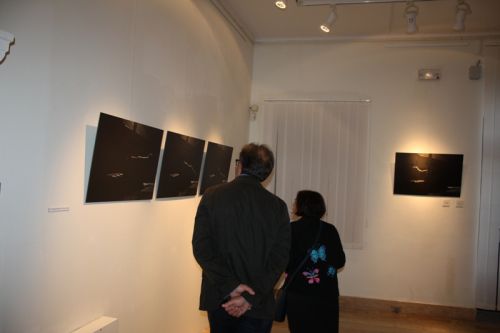
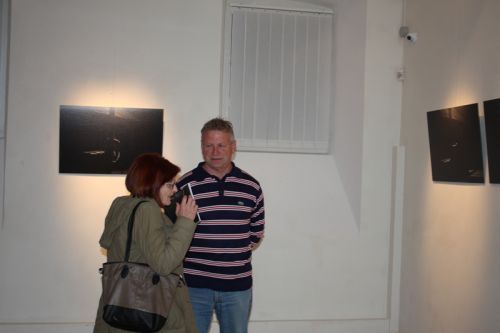
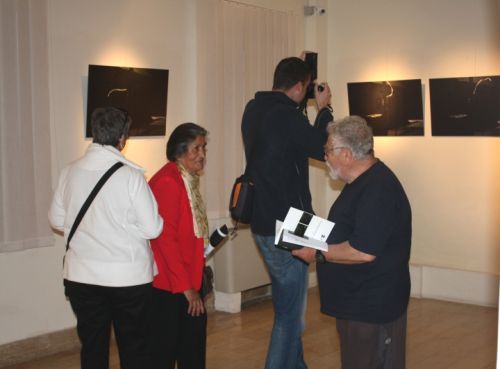
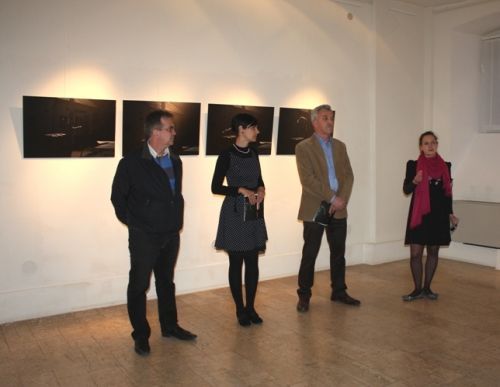
Ivan Posavec - Face lit by moonlight
Brightness of the night. Density of the dark. With this syntagma I am trying to describe the content of the twenty photographs from the series Face Lit by Moonlight. It’s inaccurate, it’s too pictur¬esque. I don’t wish to discuss the degree of illumination of a scene but I want to talk about the issue we are immersed in. About what surrounds us and is inside each of us. It’s so omnipresent that we can only notice it by its absence. Only the absence of something so ubiquitous can point towards its very existence. How does one shoot the air we breathe, or the fluid in which we dwell?
Posavec shot the distinctness of the moment. A fluid through which light moves differently. Or is it just my conscience which, immersed in another fluid, assumes a different shape. Consciousness be¬comes plasma that equals the very thing it completes it. It is made complete always and exclusively by what it can reach. There are really many things we don’t know how to think about. By breathing in something different we ourselves become different. We are what surrounds us, we are what we are immersed in.
Not one of these words describes the situation precisely enough because it presupposes the existence of something exterior and something previous. Well, I went too far describing the nature of the plasmic substance of the darkness that Posavec recorded in his series of photographs.
This time he needed the row of photographs or a sequence to prove the truthfulness of what was being observed. Really, if there was just one image taken out of the series, it would be classified as an unusual scene, romantic and appealing. A night bathed in moon¬light.
How did the vision of the world immersed in darkness reinforce itself by multiplying the scenes with minimal change? How did the Face Lit by Moonlight, with the concept of repetition with a slight variant, become visible?
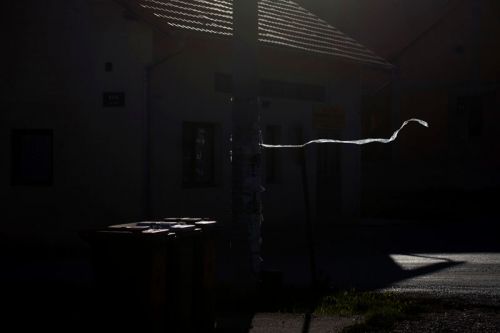
The variant is the very movement of the strip of Sellotape lit by moonlight. It itself determines the sequence as a succession in time. The simultaneous movement of the strip and the forms it ac¬quires is the second dimension of the plasmic matter in which the Faces scene has been immersed. To be able to detect the fluid in which the scene is immersed we can watch the movement of the light. The scene is static, inert but not stifled. To the contrary, there is crystal brightness in it. Therefore, we are talking about viscosity that slows the movement down, but does not reduce the visibility. The darkness is dense but not blurred.
Posavec shoots a scene in his village yard which, in a clear April night, takes his form, mirrors his inner self. The question is why and how is this happening? Is this really what it appears to be? Is the reference for real? Is it important that the moonlight is indeed in his yard or that what was shot can be read in a photograph regardless of the reference? He uses repetition to show something truly new on a familiar surface. A directed ray of light lights up a horizontal surface of the yard, perhaps a lid on a well and a downslope of a roof. The verticals are dark and block the view. The wall of the house and the pole, onto which a ribbon-like dynamic element is attached, are a totally opaque blackness. A movement reveals den¬sity, it dwindles, expressive. The position stays in the area for a long time, slowly changing. As if we were immersed in an ethereal oil. We inhale it. Fear is slowly turning into pleasure.
Marina Viculin